
OSDU Adoption: Building the AI-Ready Data Foundation for Energy
Across the energy industry, the conversation has shifted from blue-sky ambition to disciplined execution. That shift was hard to miss at India Energy Week 2026 in Goa, and it continues to shape boardroom priorities today. Whether the topic is green hydrogen, deepwater exploration, or predictive maintenance, the bottleneck is the same: turning massive, siloed datasets into insights teams can act on right now.
At ThoughtsWin, we believe the Open Subsurface Data Universe (OSDU) has outgrown its origins as a technical standard. It has become the strategic foundation for any energy leader serious about AI-readiness and operational resilience.
The "Data Paralysis" Gap: Why High-End AI Stalls
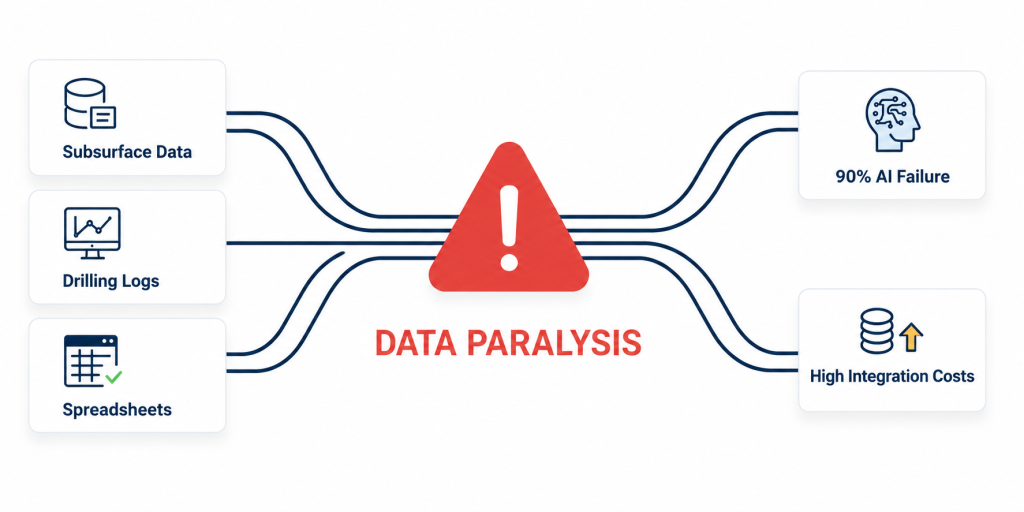
Energy operations generate staggering volumes of subsurface and geospatial data. Yet much of it stays “dark”, locked in proprietary formats and disconnected silos. Study after study finds that geoscience and engineering teams spend a large share of their time simply locating and preparing data rather than analyzing it. That is expertise spent on plumbing instead of decisions.
This fragmentation is the quiet killer of digital transformation. In its 2026 Oil and Gas Industry Outlook, Deloitte observes that a new generation of technologies, generative AI, agentic AI, and real-time analytics, is poised to move from isolated pilots to enterprise-wide deployment. The operators who capture that value won’t be the ones with the flashiest models. They’ll be the ones whose data is consistent, governed, and accessible.
The reality check: most AI programs stall not because the models are weak, but because the foundation beneath them was never built to scale.
OSDU: A Common Language for Energy Data
Think of OSDU as a common language for industrial data. Developed by The Open Group as an open, vendor-neutral framework, it standardizes how organizations organize everything from well logs to seismic surveys to production records, without locking that data inside any single application.
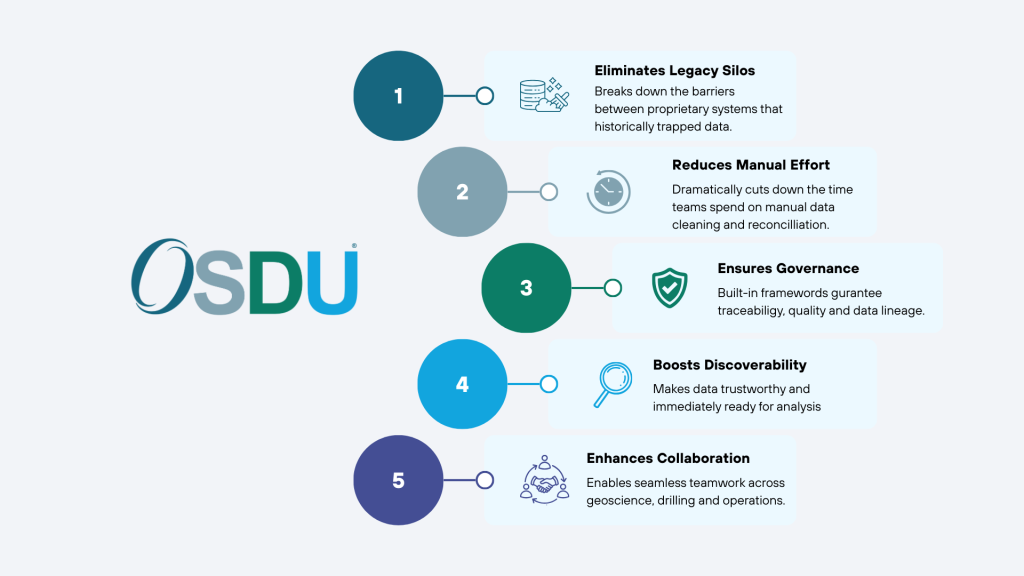
It liberates your data through five core capabilities:
- Open Data Standards: Removes constraints imposed by closed, proprietary software.
- Unified Schemas: Provides a standard method to organize wells, logs, seismic, and operational data.
- Open APIs: Supports seamless integration with diverse tools.
- Interoperability: Allows different platforms to communicate without friction.
- AI Readiness: Creates a data layer specifically designed for analytics and automation.
Why This Matters for Microsoft-Aligned Energy Teams
OSDU isn’t just a specification on a whiteboard. On the Microsoft stack, it’s already a managed, production-grade reality through Azure Data Manager for Energy (ADME), a fully managed, OSDU-compliant platform built to the OSDU Technical Standard.
What makes this powerful for teams already standardized on Microsoft: ADME’s Analytics Consumption Zone exports curated data in open Delta Parquet format, which Microsoft Fabric and Azure Databricks can read directly. In practice, that means well-governed subsurface data can flow straight into Power BI dashboards and machine-learning models, turning “energy data” into just another trusted, query-ready source in your Fabric estate. For organizations modernizing legacy reporting and analytics, this closes the loop between raw operational data, and the tools decision-makers already use every day.
From Raw Earth to Digital Gold: The Medallion Path
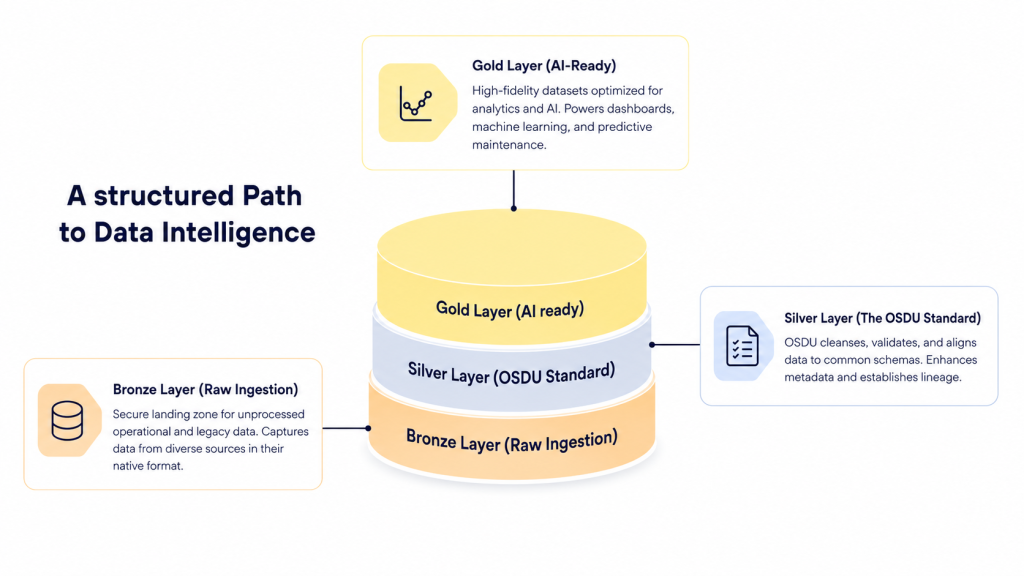
Adopting OSDU is not just about moving data, it’s about maturing it. At ThoughtsWin, we implement OSDU using a proven Medallion Architecture (the same lakehouse pattern that underpins Microsoft Fabric) to create a clear path to value:
- Bronze (raw ingestion): a secure landing zone that captures data in its native format, so nothing is lost.
- Silver (the standard): where transformation happens. Data is cleansed, validated, and conformed to OSDU schemas, turning “swampy” data into trusted records.
- Gold (AI-ready): the consumption layer. Curated, high-fidelity datasets optimized for machine learning and predictive maintenance.
What OSDU Adoption Looks Like in Practice
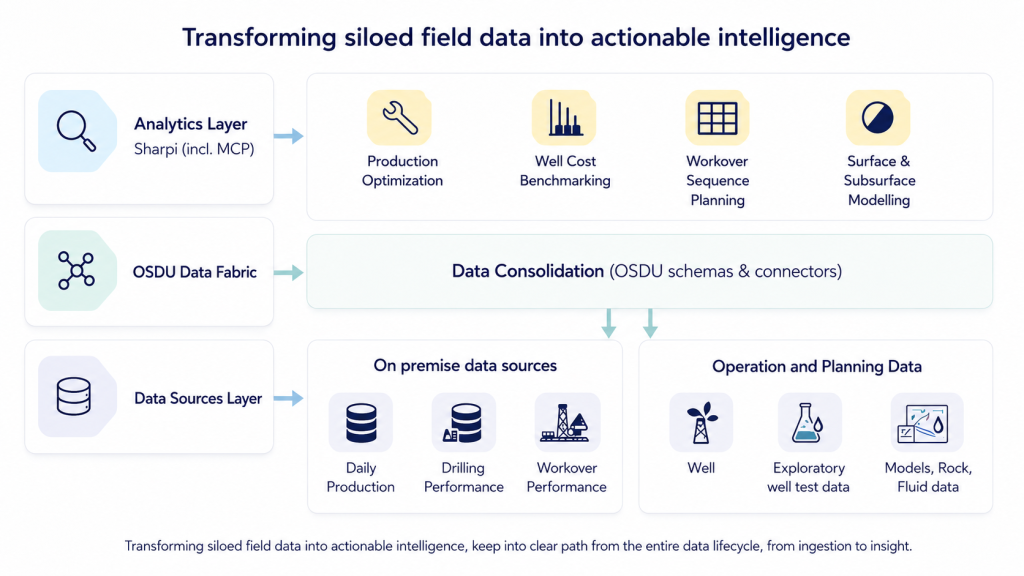
Theory is valuable, but results are what matter. In our work with energy operators deploying OSDU-conformed data fabrics, the pattern is consistent: unifying subsurface, drilling, and production datasets that once lived in isolated legacy systems.
Moving to a connected OSDU environment tends to deliver three tangible shifts:
- Domain Consolidation: Successfully bridged the gap between subsurface reservoirs and surface production systems.
- Single Source of Truth: Technical teams gained a consistent, shared view of asset data, eliminating debates over which spreadsheet was “correct.”
- Accelerated Workflows: Standardization allowed for faster access to trusted information, significantly reducing the time spent on data searching and cleaning.
See how similar data strategies apply to other sectors in our post on Optimizing the Crude Oil Supply Chain.
How ThoughtsWin Accelerates Your OSDU Journey
“Standardizing” sounds like a heavy technical lift. That’s exactly why we do not just consult, we deploy. Our toolkit helps you bypass the slow R&D phase:
- Reusable Mapping Templates: Pre-built logic for wells and seismic.
- Configurable Ingestion Pipelines: Automated workflows without manual coding.
- Automated Quality & Lineage: Built-in checks for governance.
Conclusion
The future of energy is digital, autonomous, and efficient, but you cannot build that future on a fractured foundation. OSDU gives the industry a chance to finally standardize its most critical asset: its data. And with managed platforms like Azure Data Manager for Energy and Microsoft Fabric, the path from raw subsurface data to AI-ready insight has never been shorter.